The Donner family (and the families who traveled with them, including the Reeds and the Breens) were pioneers. They had real chutzpah. They packed up their stuff, and headed for parts unknown, in search of a new life, and prosperity. Their strength of character and sense of adventure make them heroes of a sort to me. This aspect of who they were gets lost in the telling of their tragic story.
For years, I've repurposed old, metal lunchboxes. A Rambo lunchbox became a lunchbox dedicated to Great Women of Literature. Another honored Great Writers of the South. More recently, I've dedicated a lunchbox to The Donner Party. For a long time, though, I've had it in my head to create the ultimate Superhero Lunchbox...not a lunchbox featuring Batman or Wonder Woman, but a box honoring my real-life heroes.
I posed this challenge to a wide circle of friends: get your hands on a metal lunchbox, and put some thought into who or what your heroes are, and why. And then get to work making the Superhero Lunchbox of your dreams.
This online exhibit is the result of that challenge. I hope visitors to this site will find it fun and interesting, and maybe even inspiring. Lunchboxes are such useful things, and so many of us have fond memories of toting tuna sandwiches to school in our Partridge Family or Six Million Dollar Man lunchboxes. There seems to me to be no reason for us to outgrow this tradition of toting around our meals in metal boxes that say something about who we are, what we like, and what our values are. I know I've never outgrown it.
Start here, because it's what started it all for me, and work your way up. Enjoy. Leave some feedback. Make a lunchbox.
For a more detailed view, click on the individual images.
If you're moved to make a lunchbox of your own, and have it included in this exhibit, submissions are welcome. Get your hands on a metal lunchbox (no plastic, please) - you can buy a blank one from lunchboxes.com or repurpose an old one. Go to town. Choose your superhero, and and run with it. Photograph your finished lunchbox, write a few words about your subject, and send the photos and text to me at Telpher@gmail.com, with the words "Superhero Lunchbox" in the subject box.
For a more detailed view, click on the individual images.
If you're moved to make a lunchbox of your own, and have it included in this exhibit, submissions are welcome. Get your hands on a metal lunchbox (no plastic, please) - you can buy a blank one from lunchboxes.com or repurpose an old one. Go to town. Choose your superhero, and and run with it. Photograph your finished lunchbox, write a few words about your subject, and send the photos and text to me at Telpher@gmail.com, with the words "Superhero Lunchbox" in the subject box.
Thursday, July 25, 2013
Lana Nieves - The Donner Party
While I realize there's an undeniably snarky irony inherent in making a lunchbox depicting The Donner Party, I really did mean this as an homage, more than anything else. The story of The Donner Party is the dark side of the American Dream. I guess it could be seen as being a cautionary tale about hubris, but I think it's both a tragedy, and a testament to the innate human will to survive.
The Donner family (and the families who traveled with them, including the Reeds and the Breens) were pioneers. They had real chutzpah. They packed up their stuff, and headed for parts unknown, in search of a new life, and prosperity. Their strength of character and sense of adventure make them heroes of a sort to me. This aspect of who they were gets lost in the telling of their tragic story.
Sunday, February 24, 2013
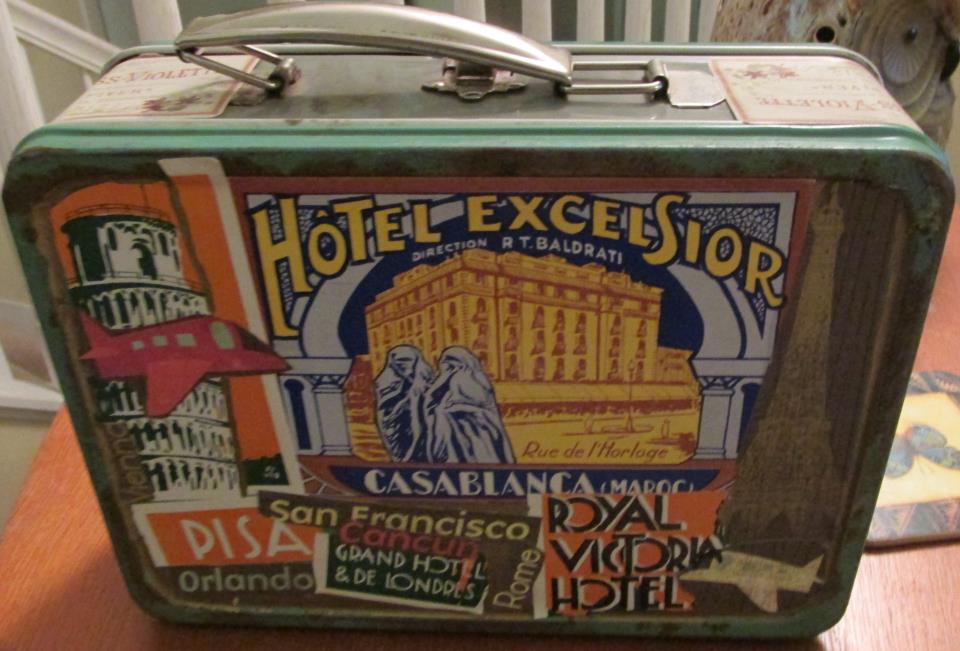
Michelle Chevallier
When I first started this artwork, I was really mulling over
who to choose. I don't really have personal heroes. I had purchased a
multipack of vintage postcards to use for another project, and I opened
it to find a bonus of not only postcards, but a pristine set of luggage
labels. I had the realization that a lunchbox is like a mini suitcase,
and the idea was born.
The problem was narrowing down the list of who to represent. There are many designers that contributed to the golden era of luggage labels, but I didn't have those of anyone famous. Eventually I decided that I would call this the Franz Lenhart/Jan Lavies Tribute Lunchbox, as both had a major influence on this "golden era."
Franz Lenhart had just enrolled at the Vienna Academy of Fine Arts when World War I began. In 1922, Lenhart moved to Florence to complete his studies at the Accademia di Belle Arti and began working as an apprentice poster designer at a local printing shop. Once Lenhart earned his diploma he moved to Merano, where he began teaching and working as an artist. A gifted portrait artist, Lenhart was a master in capturing the light and atmosphere of the Italian Alps and Dolomities.
Jan Lavies was a Dutch commercial designer who was born in Holland and spent most of his career working in the Dutch East Indies for the publicity agency Aneta. During the 1930's he designed posters, advertising, luggage labels and folders for the Netherlands-Indies Hotel Association and K.P.M. the Royal Parcel Shipping Company. Lavies received many awards and praise for his modern Art Deco designs, using strong color combinations and clean compositions. His labels capture the brilliant color and natural beauty of the aforementioned exotic lands.
My components on the front and back and interior are the luggage labels, some rubber travel related stamps, and snippets and pictures from a travel-related scrapbook sheet. I was concerned about the reaction of the old labels to any sort of sealant, so I left the front unsealed. The back required contact paper to get the rubber stamps to stay put. I'm not really happy about how the back turned out with the contact paper, but this is my first lunchbox and it turned out better than I expected.
The side panels are composed of reproduction lithograph Victorian perfume labels from Victor Vassier in Paris. I chose them because they are related to the travel theme in that they were affixed to shipping crates, instead of luggage.
The problem was narrowing down the list of who to represent. There are many designers that contributed to the golden era of luggage labels, but I didn't have those of anyone famous. Eventually I decided that I would call this the Franz Lenhart/Jan Lavies Tribute Lunchbox, as both had a major influence on this "golden era."
Franz Lenhart had just enrolled at the Vienna Academy of Fine Arts when World War I began. In 1922, Lenhart moved to Florence to complete his studies at the Accademia di Belle Arti and began working as an apprentice poster designer at a local printing shop. Once Lenhart earned his diploma he moved to Merano, where he began teaching and working as an artist. A gifted portrait artist, Lenhart was a master in capturing the light and atmosphere of the Italian Alps and Dolomities.
Jan Lavies was a Dutch commercial designer who was born in Holland and spent most of his career working in the Dutch East Indies for the publicity agency Aneta. During the 1930's he designed posters, advertising, luggage labels and folders for the Netherlands-Indies Hotel Association and K.P.M. the Royal Parcel Shipping Company. Lavies received many awards and praise for his modern Art Deco designs, using strong color combinations and clean compositions. His labels capture the brilliant color and natural beauty of the aforementioned exotic lands.
My components on the front and back and interior are the luggage labels, some rubber travel related stamps, and snippets and pictures from a travel-related scrapbook sheet. I was concerned about the reaction of the old labels to any sort of sealant, so I left the front unsealed. The back required contact paper to get the rubber stamps to stay put. I'm not really happy about how the back turned out with the contact paper, but this is my first lunchbox and it turned out better than I expected.
The side panels are composed of reproduction lithograph Victorian perfume labels from Victor Vassier in Paris. I chose them because they are related to the travel theme in that they were affixed to shipping crates, instead of luggage.
Sunday, February 10, 2013
Lana Nieves - Lana Winters
Ok, so this is a weird one. I became obsessed with season two of American Horror Story: Asylum, and its main character. The show revolves around Lana Winters, a writer and a lesbian, living life in 1960s Boston, who ends up being committed to an asylum from which there is seemingly no escape, and all because she's gay and has something to say. The asylum turns out to be a house of unspeakable horrors including filth, over-medication, physical torture, exposure to all kinds of criminally insane people (worst of all being the nuns and doctors who run the place) and a bunch of de-gayifying treatments I can't even think about. Anyhow, people kept telling me I should just stop watching, because this fucking show upset me so much, on a personal level, every week. But I couldn't stop. I. Could. Not. It was too good. The writing was too good. Sarah Paulson and Jessica Lange and Lily Rabe were too fucking good. And Lana Winters was too likable. I rooted for her. I felt obliged to see her through to the bitter end, whatever that end would be. The whole show seemed to revolve around the idea of being abandoned and forgotten because one is a misfit: it's why no one really misses Lana Winters when she's locked up, seemingly forever. Who really CARES about some woman? Some lesbian, no less? Some dumb-ass, loud-mouth, lesbian writer. Named Lana, for heaven's sake. I was soooo not going to quit this one. I'm glad I didn't. It's pretty fucking great. Lana, for all her human failings, is pretty fucking great, and gets as triumphant an ending as one can get, given the nature of this drama. How can I not have love for a story where everyone dies, except for loud-mouthed, lesbian writer named Lana? A lunchbox was definitely in order.
Wednesday, January 9, 2013
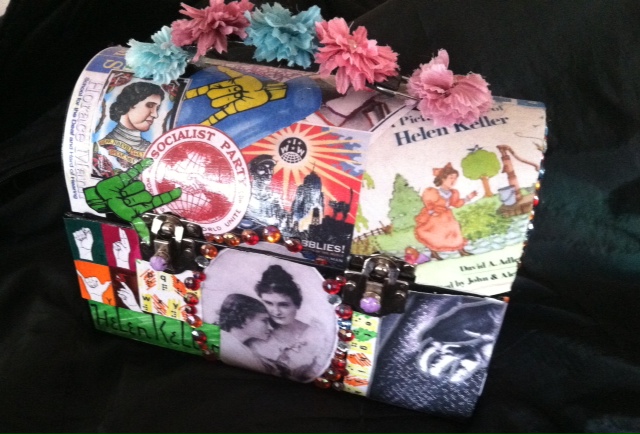
Julia Ryder Perce
Heres my effin lunch box that i was too shy to show!! And certainly stymied by having to tell WHY helen fucking keller is my personal hero!!! Fuck!! Think about it, people!!
Editor's note: While Julia gave me permission to "edit, delete, or otherwise spindle anything" she'd written, I can't think of a single edit needed in the prose above. Helen Keller WAS pretty awesome.
Thursday, January 3, 2013
Herr Metzger, Matt Polchlopek
As a fan of horror and the macabre, I have many outlets with which to share my vision. Alas, art is not one of them.
I turned to the idea of making lunchboxes because of a friend who made a Donner Party Box (and she just so happens to run this page!) Before that, I didn’t really think about working with lunchboxes too much, however, the more I thought about it, the more I realized what a perfect canvas they can be.
Sure, everyone’s seen the Spiderman’s (Spidermen?) and the Very Brady Lunchbox, but how many lunchboxes do you see dedicated to the works of Alejandro Jodorowsky? Or decorated with the face of a serial killer/cult leader? There is a niche out there for collectors young and old alike, and I aim to fill it.
Note: Matt is working on a number of lunchboxes, right now, and has other macabre creations for sale at his Etsy shop.
I turned to the idea of making lunchboxes because of a friend who made a Donner Party Box (and she just so happens to run this page!) Before that, I didn’t really think about working with lunchboxes too much, however, the more I thought about it, the more I realized what a perfect canvas they can be.
Sure, everyone’s seen the Spiderman’s (Spidermen?) and the Very Brady Lunchbox, but how many lunchboxes do you see dedicated to the works of Alejandro Jodorowsky? Or decorated with the face of a serial killer/cult leader? There is a niche out there for collectors young and old alike, and I aim to fill it.
Note: Matt is working on a number of lunchboxes, right now, and has other macabre creations for sale at his Etsy shop.
Saturday, June 23, 2012
Gerard Holmes
Why Andy Warhol? What kind of superhero is that?
I was always more of a Marvel Comics than a DC kid. The typical Marvel hero was just more interesting. Poor Peter Parker gets bitten by a radioactive spider and takes on the characteristics of a spider. He can’t actually spin webs, so he puts his mind to it and invents a web-spinner he can attach to his wrist. The Thing, alternating between laughter and rage at his misfortune: his scaly skin making it impossible to be close to the woman he loves. The Silver Surfer, whose omniscient perspective – literally looking down on the folly of humans – fills him with pity and ultimately makes him good. Cigar-smoking Howard the Duck, “trapped in a world he never made.” Dr. Strange. I could go on. The point is, these characters, two dimensional as they are, are born out of struggle, and – at least during Marvel’s heyday, the 1960s and early 1970s – they didn’t take the easy way out. They continued to struggle. Bruce Banner, nuclear scientist – staggeringly intelligent, considerate, even meek – never made peace with the roiling anger that inevitably, without fail, turned him into The Incredible Hulk.
Much more interesting than a Man who’s, you know, Super, because he fell out of the sky from another planet. Or a rich guy who likes to dress up like a bat.
Reasonable people may differ. If DC made you happy as a kid, I’m happy for you. I do know that in my later life I’ve always been drawn to people who are complicated, maybe a little mixed-up, not exactly who they seem to be at first. I like people who surprise me. I like people who struggle. I want my friends to be happy, but I can relate to the need to keep working, trying, figuring it out. I admire people who can do this with style, with grace. I especially admire people who can do this in public, maybe because I’m private.
Andy Warhol was one of those people. And that’s why he’s a superhero.
He made the world see the world his way.
I’m not talking about rising to the top of New York’s social life, or the silly Factory bullshit, or the gnomic statements. I mean his art was new and fresh and consistently strong enough, for long enough, that it made us see differently. Andy Warhol revolutionized painting, photography, film, design, even parties. Together with the Velvet Underground and some of his cronies, he created, in a hole-in-the-wall on St. Mark’s Place, the lightshow that bands were STILL using when I started gong to concerts in the early 1980s, and a kind of everything-all-at-once music / theater hybrid that was still considered avant-garde when I moved to New York in the 1990s.
Did he eventually rest on his laurels? Did he let other people tell his story and go along with it, and cater to the rich and stop paying attention at some point? Yes. So what? Picasso had a long, silly, repetitive decline punctuated with occasional, probably accidental greatness, too. That doesn’t matter.
Maybe it’s that I grew up caring more about music than art per se. A great band is a band that has a strong five-year run, with maybe three albums you want to listen to for the rest of your life, and two more that are worth holding on to. The Beatles had a seven- or eight-year run, maybe, as a recording band, depending on how you’re counting. Then a lot of solo nonsense with occasional flashes of greatness… usually when Ringo was in the room. But that’s a different ax to grind.
I’ve purposely avoided the Marilyns and soup cans and such here, even though I think they’re great (a new kind of portrait and still life, respectively). I went with the banana, first because the Velvet Underground’s first record was – probably – the first time I actually sat down and looked intentionally at a work of visual art; second because it freshly struggles with one of the fundamental themes of Western art: the urge to reveal, and simultaneously to hide, sexual passion. The banana, originally printed as a sticker with “Peel Slowly and See” above its apex, is sexy. Sexier than Mick Jagger’s crotch on “Sticky Fingers” (though that, with its built-in zipper, was funnier). I was lucky to find a pic online of the banana – the pink banana – partly unsheathed.
I wanted to include one of the electric chairs. These are some of the most powerful works of art I know of. They’re like all of Truman Capote’s “In Cold Blood” at once. They don’t reproduce well, though. Instead, I included one of Warhol’s skulls, a take on the momento mori theme that would be obvious if it weren’t so beautifully composed. Stop and look at how the colors interact, and how unexpected, and probably garish, each of them would be if they were used, individually, on a silkscreen of a skull. Together – somehow, I don’t know why – they support each other. It’s hideous and terrifying and hilarious and electrifying.
Andy himself appears on the top and bottom.
And inside, because – after all – it’s a lunchbox, a reminder of where your roast-beef sandwich came from.
There’s a lot more to say. In his best work Warhol drew from the things everyone was looking at but not seeing, tweaked them, put them up on the wall (or on the floor, or just filled up the room with them), and made everyone see: not only the representation, which is enough, but the original, differently. Leonardo did that with the nude. Ingres did it with the portrait. And Warhol did it with the stuff and people all around us, the unavoidable, endlessly repeating people and things that constantly wash up on the pop-culture shore. He does it funny but generally resists the temptation to slapstick.
Why is there so little on the lunchbox? I’ve always loved the rectangular silver balloons Warhol designed and let float around at parties, and when my boxes arrived in the mail – each cardboard box stamped “Plain Metal,” the brushed-steel surface of each lunchbox palely reflective, I thought instantly of Warhol and set aside my plans for a Walt Whitman box. (Maybe that will come later.) His best art – from the 60s and early 70s, and then the reawakening in the late 1980s – is simple and spare but unfussy about details. It seemed to me like a Warhol lunchbox should follow the same aesthetic. So I didn’t try to hide the “brushstrokes” of my adhesive, and I didn’t worry if the ink ran a bit, but I tried to put the right images in the right places.
Tuesday, May 1, 2012
Jennifer Hayes
The lighting in my office is crappy, and I couldn't see all my imperfections as I was working. But the more I see them now, the more it really describes my family. And it gives me a little knot in my throat.
I created my lunchbox in the same way I do my other projects, in boxes so that the piece has a keepsake feel.
My super heros are my parents (and my grandma). Both of my parents grew up poor (my mother didn't even have indoor plumbing in her house). So they both worked really hard to give me and my brother everything they couldn't have growing up.
When I was younger, my dad was in the Army and his position kept him away for long periods of time. My mom had to take care of my brother and me by herself, often in another country where she didn't know anyone or even know the language. She worked office jobs to help pay the bills and save money. We didn't have much, but they loved us, and we always had a roof and food. Even the years when we weren't sure we were even going to have a Christmas tree, my mom worked several jobs to get each of us a little something. I'm glad that they love me unconditionally, tattoos, pink hair and all.
So I turned my parents into some of my own favorite things... paper dolls.
My grandmother had seven children, lived through the great Depression and once lived in a tent with her little ones and husband. She passed away when I was 12, but I will always remember her as one of the nicest, strongest women I've ever known. Her laugh was loud and infectious, as was her desire to help others.
A note from Jenn: I totally meant to add that the letter wrapped around the box is from when he was stationed in Germany for two years when I was younger, and would write to me. I was terrible about writing back, but I still have his letters. Their wedding photo is also inside as well.
Subscribe to:
Posts (Atom)